Get to know any codebase.

Paste a GitHub repo and read it like a manual — what every part does, how it all connects, and what breaks if you touch it. One sweep, about a minute, nothing to install.

Sweeping your own repo takes a free account — we'll keep the URL and run it the moment you land. Or read one already swept, no account at all.

Read one now, without signing up.

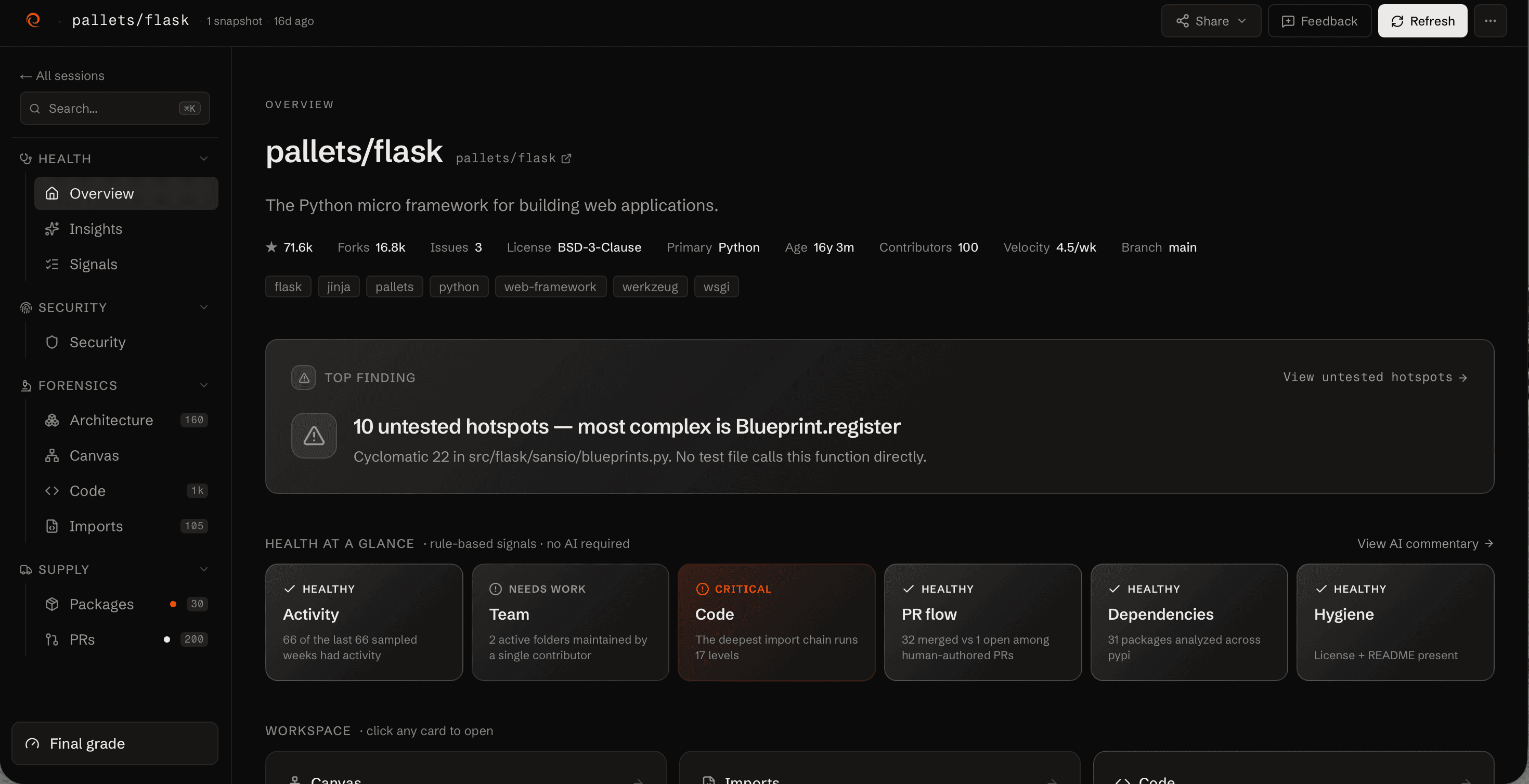
Three repos already swept. Every panel is open — the source, the call graph, the findings, the grade. These are the real reports, not a tour.

01Paste a repoAny GitHub URL — public or private. Nothing to install, nothing to configure.
02One sweep, about a minuteFull git history, AST structure, security, dependencies — computed in a single pass.
03Read the manualA grade to orient you, then the survey: source, Faultline, signals — every claim with its evidence.

Read the code, with the map drawn on it.

Every function carries its computed complexity, its callers, and its risk. Click one and the AI explains what it does in plain language — sent on your click, never stored.

codetrawl.com — source
lib/codeAnalysis/plugins/javascript.ts·coffeejones/gitvision
6965 function lookupVariableType(name: string): string | null {
697 for (let i = methodStack.length - 1; i >= 0; i--) {
698 const t = methodStack[i].locals.get(name);
699 if (t) return t;
700 }
701 const cls = currentClass();
702 if (cls) {
703 const t = cls.fields.get(name);
704 if (t) return t;
705 }
706 return null;
707 }
lookupVariableTypeComplexity 5Called from 74 twinsNo test guards it
What it doesSearches a stack of method scopes and the current class for a variable's type, returning the first match or null.
Where the risk isThe function is structurally duplicated 4 times elsewhere in the codebase, and the file containing it is not reached by tests, making it difficult to verify correctness across all copies if the logic needs to change.
Worth consideringExtract this lookup logic into a shared utility function to consolidate the 4 duplicates and reduce maintenance burden.
Reads this function’s source with AI — sent to Anthropic on your click, never stored.Haiku 4.5
codetrawl.com — faultline
High riskif you delete lib/db/index.ts
index.ts is load-bearing — deleting it breaks 15 files, 12 with no test to catch it.
DELETEindex.tslib/db/page.tsx…/account/billing/NO TESTpage.tsx…/account/connections/NO TESTpage.tsx…/account/security/NO TESTroute.ts…/admin/reset-billing/NO TESTroute.ts…/api/billing/cancel/NO TESTroute.ts…/billing/change-plan/NO TESTroute.ts…/api/billing/portal/NO TESTroute.tsapp/api/polar/webhook/NO TESTauth.tslib/NO TESTrefreshQuota.tslib/billing/NO TESTgithubUserToken.tslib/NO TESTwatches.tslib/NO TESTgates.tslib/billing/COVEREDmetrics.tslib/COVEREDwatchMonitor.tslib/COVERED
  • page.tsx
    app/(workspace)/account/billing/NO TEST
  • page.tsx
    app/(workspace)/account/connections/NO TEST
  • page.tsx
    app/(workspace)/account/security/NO TEST
  • route.ts
    app/api/admin/reset-billing/NO TEST
  • route.ts
    app/api/billing/cancel/NO TEST
  • route.ts
    app/api/billing/change-plan/NO TEST
  • route.ts
    app/api/billing/portal/NO TEST
  • route.ts
    app/api/polar/webhook/NO TEST
  • auth.ts
    lib/NO TEST
  • refreshQuota.ts
    lib/billing/NO TEST
  • githubUserToken.ts
    lib/NO TEST
  • watches.ts
    lib/NO TEST
  • gates.ts
    lib/billing/COVERED
  • metrics.ts
    lib/COVERED
  • watchMonitor.ts
    lib/COVERED
15 files break12 with no test1 hop — direct importers only

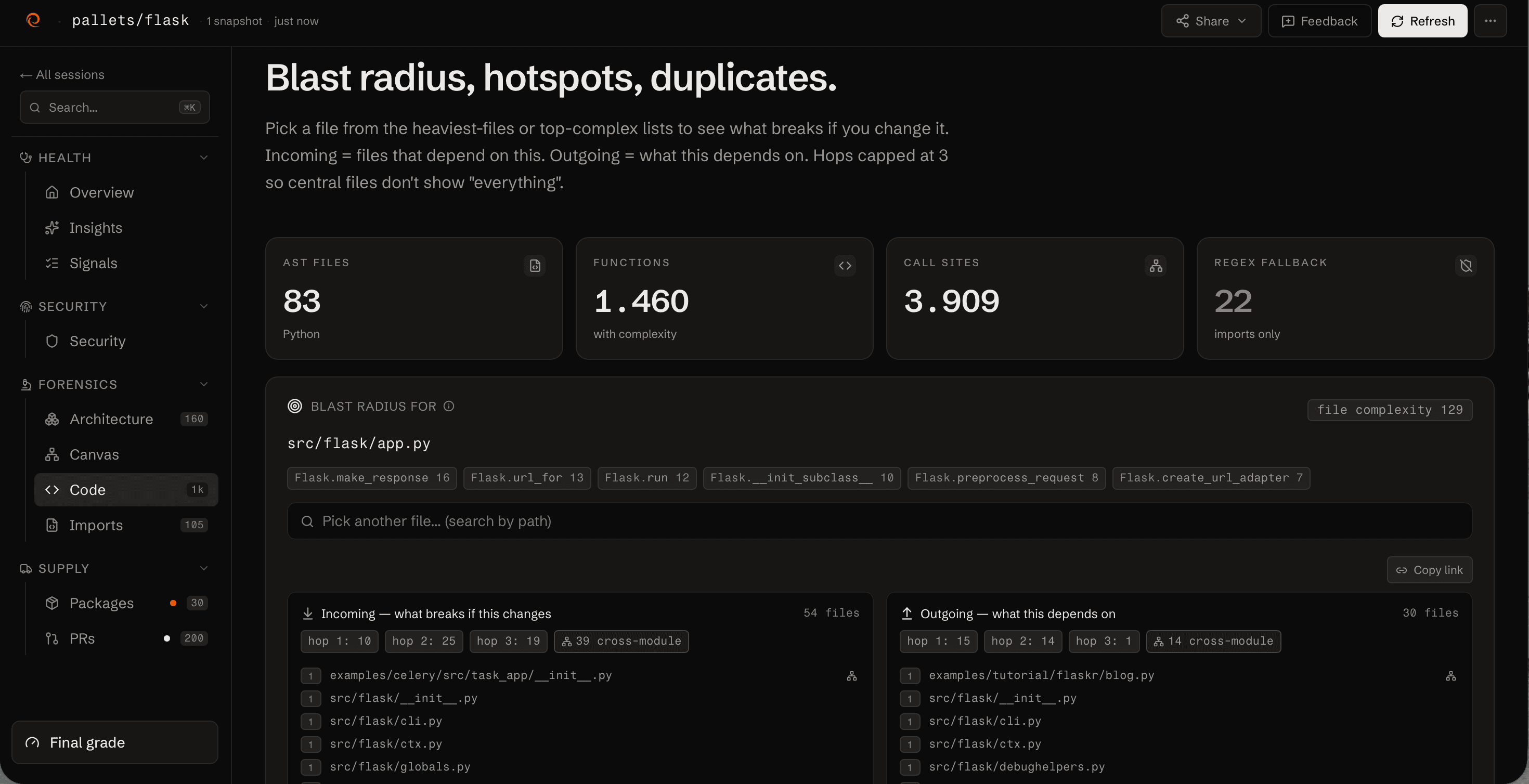
Know what a change breaks — before you make it.

Pick a file and simulate deleting or changing it. The call graph shows exactly which files break, and which ones have no test to catch it. Understanding how a repo holds together, made literal.

The dangerous code, matched to the line.

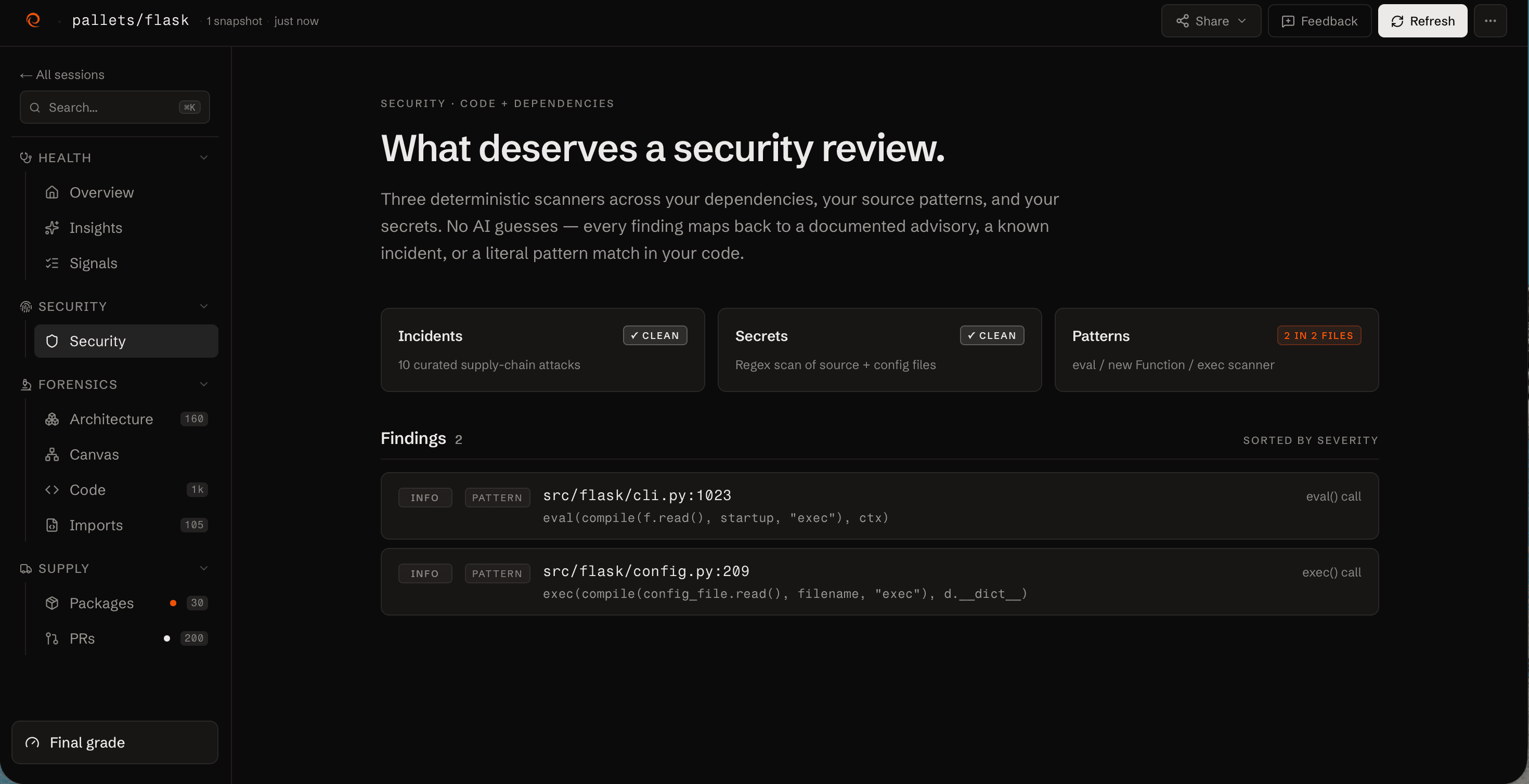
Three deterministic scanners — secrets, dynamic-execution patterns, and known supply-chain incidents. Every hit is pinned to the exact line, or the exact package. Matched against the record, never a guessed CVE.

codetrawl.com — security
Security · Code + dependencies

What deserves a security review.

2 informational

Incidents

Clean

10 curated supply-chain attacks

Secrets

Clean

Regex scan of source + config files

Patterns

2 in 2 files

eval / new Function / exec scanner

Findings2

Sorted by severity

Everything one sweep reads.

Eight ways of reading a codebase, computed in a single pass and cross-linked — follow any thread to the evidence it came from.

01Git historyWho really owns each corner — and where change keeps piling up.
02StructureHow the pieces connect: call graphs, import chains, dead ends.
03SourceThe code with every finding drawn on it, function by function.
04FaultlineWhat breaks if you change a file — before you change it.
05SecuritySecrets, risky eval, known incidents — matched to a line, not guessed.
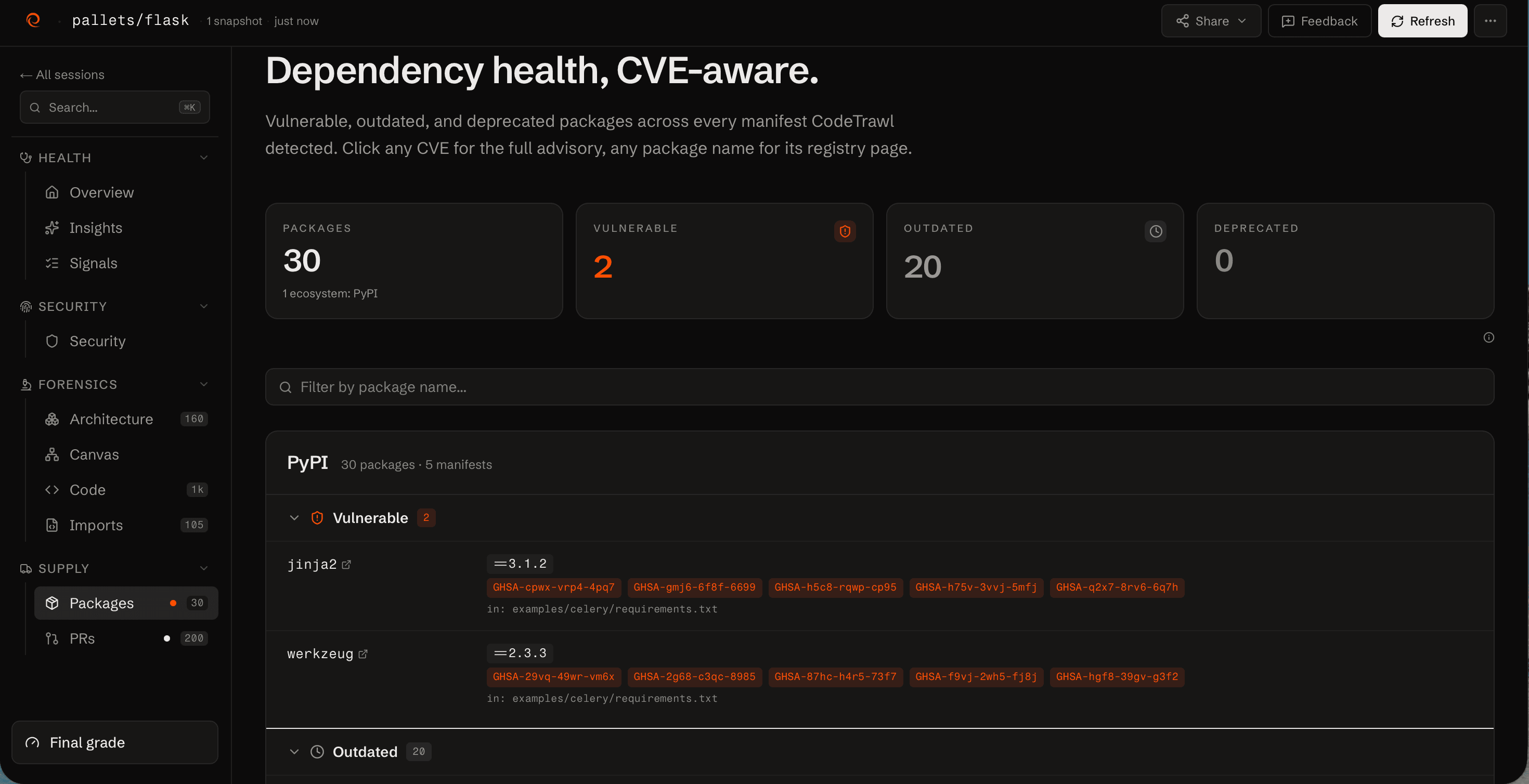
06DependenciesWhich packages carry CVEs or have drifted out of date.
07DuplicatesThe same function body, copy-pasted where it shouldn't be.
08DiagramsThe type graph and architecture, drawn from the code itself.

Computed, never generated. Every finding is measured from the real code — tree-sitter ASTs, full git history, resolved dependency graphs. The AI narrates what was found; it never invents it.

Questions worth asking first.

Where does my code go?
We take two temporary copies to analyze it — a metadata-only git clone for history, and the repository archive, because the parsers have to read the files — and the analysis process deletes both when it is done. What we keep afterwards is the result: paths, structure, symbol names, metrics, findings. Not your files, with a short list of named exceptions we spell out rather than round off. The whole answer is on one page, including the parts that are inconvenient for us.
Is this just an LLM guessing about my repo?
No — the analysis engine calls no AI at all. The clone, the parse, the call graph and every signal are computed by code, and with no API key configured the product loses its narration and nothing else. The AI layer sits on top in three clearly different shapes: the health verdict is written from the computed signals alone, the briefing also draws on what the model knows about well-known projects, and the per-function explainer reads that one function’s source when you click it. We split those out instead of claiming the strongest one covers all three.
What does it cost?
Every panel is free on one repo, private repositories included — the source browser, the call graph, Faultline, the AI briefing, the grade. Nothing is held back to make the free tier feel thin. What you pay for is keeping more than one repo on the go, a grade on every pull request, and a daily re-sweep that tells you when something regressed. Plans and limits.
What happens if CodeTrawl disappears?
The source is public and licensed under PolyForm Noncommercial, so you can read exactly what it does to your code and run it yourself — the MCP server is one npx command and does its analysis on your machine, with no CodeTrawl server in the path at all. We are one person, not a funded team, and we say so plainly; that is the reason the escape hatch exists rather than something to discover later.

Read your first repo now.

Free on one repo — private repos included. Nothing to install.

Sweeping your own repo takes a free account — we'll keep the URL and run it the moment you land. Or read one already swept, no account at all.